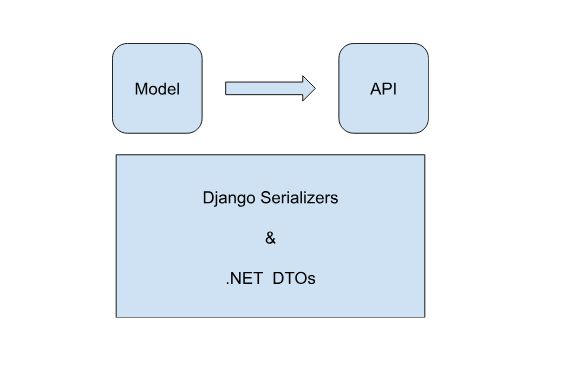
Working across different frameworks? You'll notice that Django's Serializers and .NET's DTOs serve the same purpose - just with different syntax. Let's explore how these patterns translate between ecosystems.
The Same Problem, Different Solutions
Whether you're building APIs in Django or .NET, you face a common challenge: how do you control what data goes in and out of your API? You don't want to expose your entire database model to the world.
Architectural patterns transcend programming languages. Django Serializers and .NET DTOs solve the same problem - they're just wearing different clothes.
Why Use Serializers/DTOs?
Avoid Leaking Full Database Models
Your internal data structure shouldn't be your API contract. Keep sensitive fields hidden and maintain flexibility to change your database without breaking clients.
Add Structure and Validation
Define exactly what fields are required, their types, and validation rules. Catch bad data before it hits your business logic.
Control Data Flow
Specify exactly what data goes in (request) and what comes out (response). Different endpoints can expose different views of the same model.
Django Serializers
In Django REST Framework, Serializers handle the conversion between complex types (like Django models) and Python native datatypes that can be rendered to JSON:
Django Example
class ProductSerializer(serializers.ModelSerializer):
class Meta:
model = Product
fields = ['name', 'price']
With just a few lines, you've defined exactly which fields from your Product model will be exposed through the API. The full model might have created_at, cost_price, supplier_id - none of that leaks to the client.
.NET DTOs (Data Transfer Objects)
In .NET, DTOs are simple classes that define the shape of data being transferred. They're separate from your Entity Framework models:
C# (.NET) Example
public class ProductDto
{
public string Name { get; set; }
public decimal Price { get; set; }
}
Same concept, different syntax. Your Entity model might have 20 properties, but you only expose what the client needs.
Side-by-Side Comparison
Key Differences
- Django: Serializers are tightly integrated with DRF and can auto-generate from models
- .NET: DTOs are plain classes - you manually map between Entity and DTO (or use AutoMapper)
- Django: Built-in validation through serializer fields
- .NET: Validation through Data Annotations or FluentValidation
- Both: Separate your API contract from your database schema
The Bigger Picture
Learning one framework deeply teaches you patterns that apply everywhere. Once you understand why Serializers exist in Django, you'll immediately recognize what DTOs do in .NET, ViewModels in ASP.NET MVC, or Response Models in FastAPI.
The syntax changes, but the thinking stays the same. That's the beauty of understanding architectural patterns rather than just memorizing code.
Working with multiple frameworks? Share your experiences translating patterns between ecosystems!